
When most people think about traffic safety, they rely on more than just their eyes.
They listen.
The rumble of a truck. The whine of a motorcycle. The sound of tires approaching from behind. Those noises give pedestrians, joggers, dog walkers, and even drivers precious extra seconds to recognize danger and react.
But many electric bicycles and e-scooters are changing that equation.
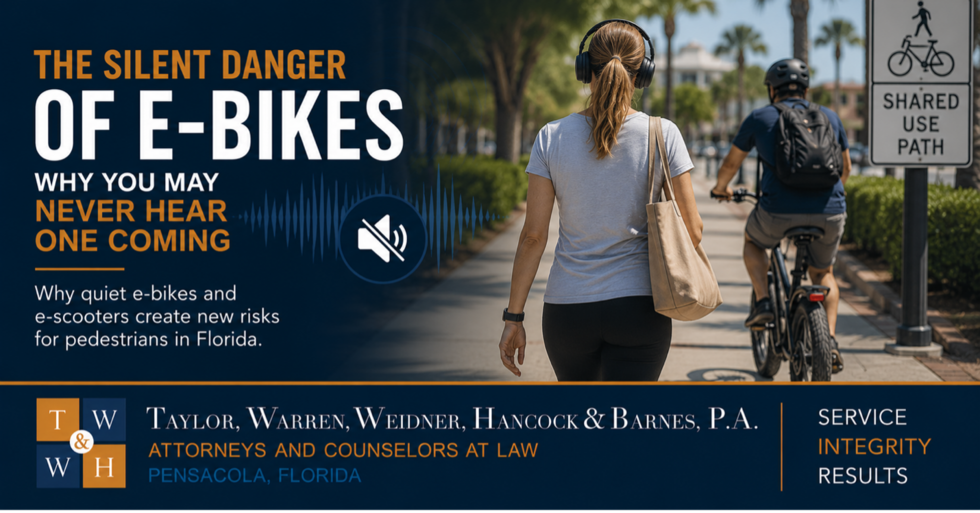
Unlike traditional motorcycles or gas-powered scooters, many e-bikes operate almost silently. While that makes for a smoother and more enjoyable ride, it also creates a new safety challenge: people often don't realize an e-bike is approaching until it's only a few feet away.
Our Ears Help Keep Us Safe
Most of us don't consciously think about it, but hearing is one of our most important safety tools.
Imagine walking along Pensacola Beach, strolling through Historic Downtown Pensacola, or enjoying one of Florida's many shared-use paths. Before stepping slightly to one side or changing direction, many people instinctively listen for approaching traffic.
That instinct has worked well for decades.
Now imagine an electric bicycle approaching from behind at 20 miles per hour with almost no engine noise.
Without an audible cue, a pedestrian may unknowingly step into the rider's path at exactly the wrong moment.
Neither person intended for a collision to happen, yet both may have only a split second to react.
It's Not Just About Pedestrians
The lack of noise affects more than people walking.
Drivers pulling out of driveways or parking lots often rely on both sight and sound before entering traffic. A quiet e-bike approaching from the sidewalk or bike lane may be traveling much faster than a driver expects.
Children may dart onto sidewalks without hearing an approaching rider.
Older adults may have slower reaction times.
Individuals with visual impairments often depend heavily on sound to understand what is happening around them.
When everyone shares the same space, silence can sometimes become a hazard.
Florida Is Responding to This Growing Safety Concern
As electric bicycles become more common across the state, Florida lawmakers have recognized that courtesy alone isn't always enough.
Beginning July 1, 2026, riders on shared-use pathways that are not adjacent to a roadway must yield to pedestrians and provide an audible signal—such as a bell or a verbal warning like "Passing on your left"—before overtaking someone. Riders on sidewalks must also slow to 10 miles per hour when pedestrians are within 50 feet. These changes are designed to reduce collisions caused by surprise rather than recklessness.
You can read more about Florida's new e-bike safety requirements in the Florida Senate's bill summary:
https://www.flsenate.gov/Session/Bill/2026/382
The new rules recognize a simple reality: people cannot react to what they never hear.
A Small Warning Can Prevent a Serious Injury
Fortunately, preventing many of these crashes doesn't require expensive equipment.
A simple bicycle bell.
A quick "On your left."
Slowing down before passing.
Making eye contact when possible.
These small actions give pedestrians the information they need to respond safely.
Likewise, pedestrians should remain aware of their surroundings whenever possible. Walking while wearing noise-canceling headphones or focusing entirely on a phone can make it even harder to detect approaching traffic.
Safety works best when everyone shares responsibility.
The Bottom Line from TWWLAWFIRM.COM
Electric bikes are becoming a valuable part of Florida's transportation system, offering an efficient and environmentally friendly way to travel. But their quiet operation creates a unique challenge that many people haven't yet learned to anticipate.
Whether you're riding an e-bike, walking your dog, or simply enjoying a neighborhood sidewalk, remember that communication matters. A simple audible warning—and a little extra awareness from everyone sharing the path—can make the difference between a close call and a life-changing injury.


Comments
There are no comments for this post. Be the first and Add your Comment below.
Leave a Comment