
In May 2026, 21-year-old University of South Florida student Lauryn Akey sent her family a simple text message. She told them she loved them and that she was on her way home.
According to news reports, those would be among her final words.
Minutes later, Akey was killed in a wrong-way crash on Interstate 75 in Southwest Florida. Authorities later alleged that the driver responsible had a blood alcohol concentration nearly three times Florida's legal limit. Stories like this are heartbreaking because they are so preventable.
Every year, families across Florida receive phone calls that change their lives forever. A son, daughter, spouse, parent, or friend leaves home expecting an ordinary day and never returns. In many of those cases, alcohol or drug impairment plays a role.
While criminal charges may eventually be filed, families are often left asking a deeper question:
How could this have happened in the first place?
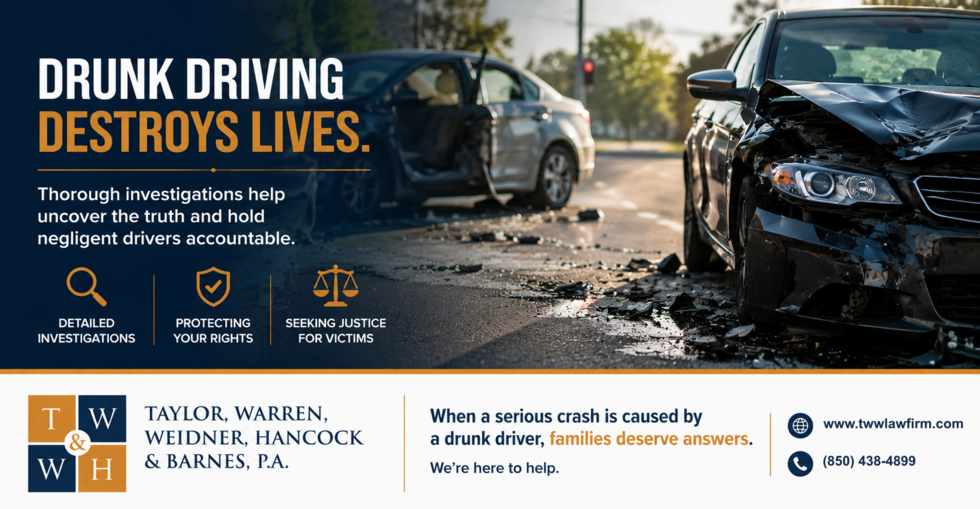
The Devastating Impact of Drunk Driving
Drunk driving crashes are different from many other accidents. Mechanical failures happen. Weather conditions change. Drivers make mistakes.
But impaired driving is a choice.
Someone makes the decision to consume alcohol or drugs and then get behind the wheel of a vehicle that can weigh thousands of pounds and travel at highway speeds. When that decision results in a crash, innocent people often pay the price.
The consequences can be catastrophic:
- Fatal injuries
- Traumatic brain injuries
- Spinal cord injuries
- Permanent disabilities
- Emotional trauma for surviving family members
The damage extends far beyond the crash itself. Families are left grieving, children lose parents, parents lose children, and entire communities are affected.
Why Evidence Matters
In the aftermath of a suspected impaired-driving crash, investigators work to gather evidence that can help explain what occurred. Law enforcement officers, prosecutors, accident reconstructionists, and civil attorneys may all examine different pieces of evidence depending on their role and the questions they are trying to answer.
Investigators may rely on:
- Blood alcohol testing
- Toxicology reports
- Witness statements
- Surveillance footage
- Vehicle data
- Officer observations
- Crash reconstruction evidence
Together, these pieces of evidence help establish what happened and why.
For families, obtaining answers can be an important part of the healing process. They want to understand whether impairment contributed to the crash and whether the tragedy could have been prevented.
The facts matter.
The truth matters.
And preserving evidence early often plays a significant role in uncovering both.
Criminal Cases and Civil Cases Serve Different Purposes
When a suspected impaired driver causes a serious crash, law enforcement officers and prosecutors may pursue criminal charges where the evidence supports doing so.
Criminal investigations, however, operate under constitutional protections and evidentiary standards designed to safeguard individual rights. Officers often must make decisions based on the information available at the scene and during the early stages of an investigation, frequently while managing emergency response efforts and public safety concerns.
Civil investigations serve a different purpose. Rather than determining criminal guilt, they focus on uncovering facts, identifying responsible parties, and obtaining compensation for those harmed by negligent conduct.
Civil investigations frequently examine additional questions, including:
- Whether bars or restaurants may have overserved an intoxicated person
- Whether other parties contributed to the crash
- Whether critical evidence has been preserved
- The full extent of the victim's losses and damages
The criminal justice system and the civil justice system are not competing processes. They serve different functions, often working toward the same goal: uncovering the truth and promoting accountability.
A civil claim cannot undo a tragedy. It cannot replace a loved one. But it can help families seek accountability and obtain the resources they need to move forward.
A Reminder for Every Florida Driver
The story of Lauryn Akey is a painful reminder that drunk driving continues to affect families across Florida.
A text message saying, "I'm on my way home," should not become a family's final memory of a loved one.
Every driver has a responsibility to make safe choices before getting behind the wheel. The decision to drive impaired can alter countless lives in a matter of seconds.
The Bottom Line from TWWLAWFIRM.COM
At Taylor, Warren, Weidner, Hancock & Barnes, P.A., our experienced car accident attorneys have seen firsthand the devastation serious crashes can cause. When alcohol or drugs may have played a role, both criminal and civil investigations can play an important role in understanding what happened and pursuing accountability.
Families deserve answers, and they deserve access to the legal tools available to uncover facts and seek accountability when negligence causes harm.
If you have questions following a serious crash involving suspected impaired driving, our attorneys are available to help evaluate the circumstances and protect your family's rights.
Because every family deserves to know the truth.


Comments
There are no comments for this post. Be the first and Add your Comment below.
Leave a Comment