
Some cases resolve quickly.
Others test whether a lawyer is really willing to keep going when the case becomes difficult.
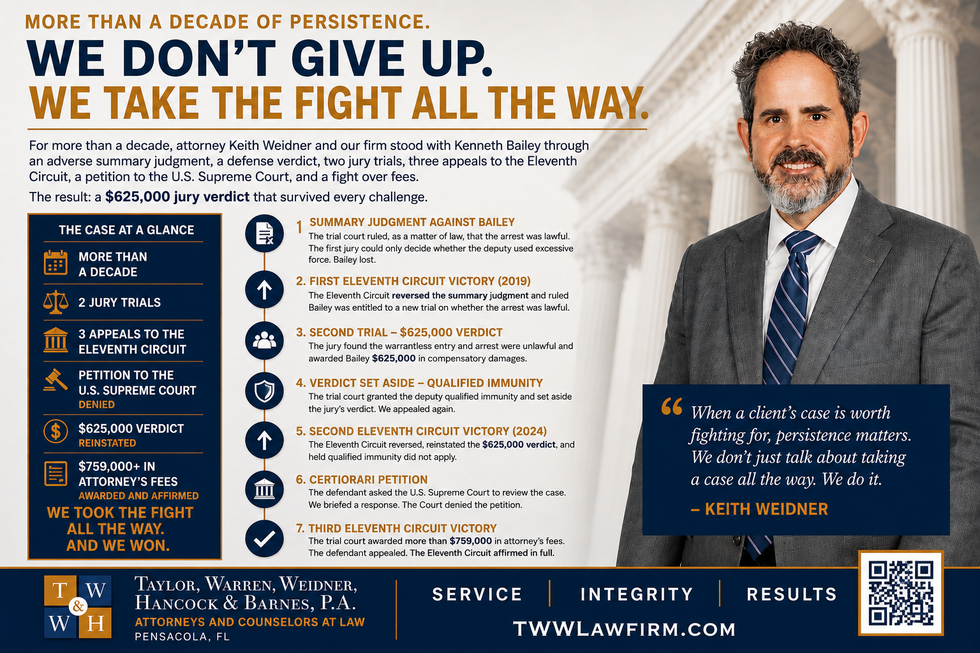
For more than a decade, attorney Keith Weidner and Taylor, Warren, Weidner, Hancock & Barnes stood with Kenneth Bailey through an adverse summary judgment, a defense verdict, two jury trials, three trips to the United States Court of Appeals for the Eleventh Circuit, post-trial proceedings, and an effort by the defendant to take the case to the United States Supreme Court.
At several points along the way, the case could have ended.
We kept going.
Ultimately, Bailey obtained a $625,000 jury verdict for the injuries he suffered, and that verdict survived every challenge that followed.
The Bailey case demonstrates something we believe about representing injured people:
When a client's case is worth fighting for, persistence matters.
How the Case Began
Kenneth Bailey was confronted by a deputy sheriff outside his parents' home during an investigation into a domestic dispute.
Bailey came outside and spoke with the deputy. When Bailey later returned inside the home, the deputy followed him through the doorway. A physical confrontation followed. Bailey was tackled, tased, and arrested.
Bailey suffered a significant injury during the encounter that ultimately forced him to leave his career with the United States Air Force.
What began as an injury case would ultimately become more than a decade of litigation.
First, We Lost Before the First Trial Even Began
Before the first trial, the federal district court granted summary judgment on a critical issue.
The court ruled, as a matter of law, that Bailey's arrest was lawful.
That ruling dramatically changed what the jury would be permitted to decide. Instead of determining whether the deputy was legally justified in entering the home and arresting Bailey, the first jury was limited to deciding whether the deputy used excessive force during what it had been instructed was a lawful arrest.
Bailey lost.
The jury found that the deputy had not used excessive force.
For many cases, that combination—an adverse summary judgment followed by a defense verdict—would have been the end.
Keith appealed.
The First Eleventh Circuit Victory
Keith challenged the summary-judgment ruling in the United States Court of Appeals for the Eleventh Circuit.
In 2019, the Eleventh Circuit reversed.
The appellate court concluded that the trial court should not have taken the legality of the arrest away from the jury. The ruling gave Bailey the opportunity to return to the trial court and have a jury decide the issue that had been removed from the first trial.
The case came back.
And we prepared to try it again.
The Second Trial—and a $625,000 Verdict
At the second trial, the jury was finally permitted to decide whether the deputy's warrantless entry into the home and Bailey's arrest were legally justified.
This time, Bailey won.
The jury found that no exigent circumstances justified the deputy's entry into the home and awarded Bailey $625,000 in compensatory damages.
After years of litigation and a second jury trial, it appeared that Bailey had finally prevailed.
But the case still was not over.
The Verdict Was Taken Away
After trial, the district court granted the deputy qualified immunity and set aside Bailey's victory.
So, despite winning a $625,000 jury verdict, Bailey once again found himself with no judgment in his favor.
Keith appealed again.
The Second Eleventh Circuit Victory
In 2024, the Eleventh Circuit reversed the district court for a second time.
The court concluded that the law was clearly established and that qualified immunity did not protect the deputy from liability. The Eleventh Circuit reinstated Bailey's victory.
The $625,000 verdict was back.
The defendant then asked the United States Supreme Court to review the case.
Defending the Victory Before the U.S. Supreme Court
The defendant filed a petition for a writ of certiorari with the United States Supreme Court.
That required Keith and the firm to continue the fight. Keith became our first attorney admitted to practice before the United States Supreme Court this time briefing a response explaining why the Supreme Court should not disturb Bailey's victory.
The Supreme Court denied the petition.
The $625,000 verdict remained intact.
But remarkably, even that was not the end of the litigation.
A Third Trip to the Eleventh Circuit
After Bailey prevailed, the district court determined the attorney's fees the defendant was required to pay.
The court awarded more than $759,000 in attorney's fees after years of litigation.
The defendant appealed again.
That meant a third trip to the Eleventh Circuit.
And a third victory.
The Eleventh Circuit upheld the trial court's decision awarding the fees incurred in pursuing Bailey's case.
Only then—after more than a decade, two jury trials, three successful appeals, and proceedings reaching all the way to the U.S. Supreme Court—was the litigation finally at an end.
What Persistence Actually Looks Like
It is easy to say that a law firm is willing to take a difficult case all the way.
The Bailey case shows what that can actually mean.
· It meant continuing after the trial court ruled against our client before the first trial.
· It meant continuing after a jury returned a defense verdict.
· It meant appealing—and winning.
· It meant preparing the entire case for trial again.
· It meant winning a $625,000 verdict, only to have that victory taken away.
· It meant appealing again—and winning again.
· It meant responding when the defendant asked the United States Supreme Court to overturn that victory.
· And even after the Supreme Court declined review, it meant returning to the Eleventh Circuit a third time when the defendant challenged the attorney's-fee award.
Three trips to the Eleventh Circuit. Three victories. Two jury trials. One case. More than a decade.
That is persistence.
When a Case Is Worth Fighting For
Every case is different.
Not every lawsuit should be tried. Not every adverse ruling should be appealed. And persistence does not mean pursuing litigation simply for the sake of pursuing it.
It means having the judgment to recognize when a case deserves to continue—and the experience, resources, and resolve to keep going when it does.
For Kenneth Bailey, that meant more than a decade of litigation.
As Keith puts it:
“When a client's case is worth fighting for, persistence matters. We don't just talk about taking a case all the way. We do it.”
— Keith Weidner
For more than a decade, that is exactly what we did.
SERVICE • INTEGRITY • RESULTS

Comments
There are no comments for this post. Be the first and Add your Comment below.
Leave a Comment