
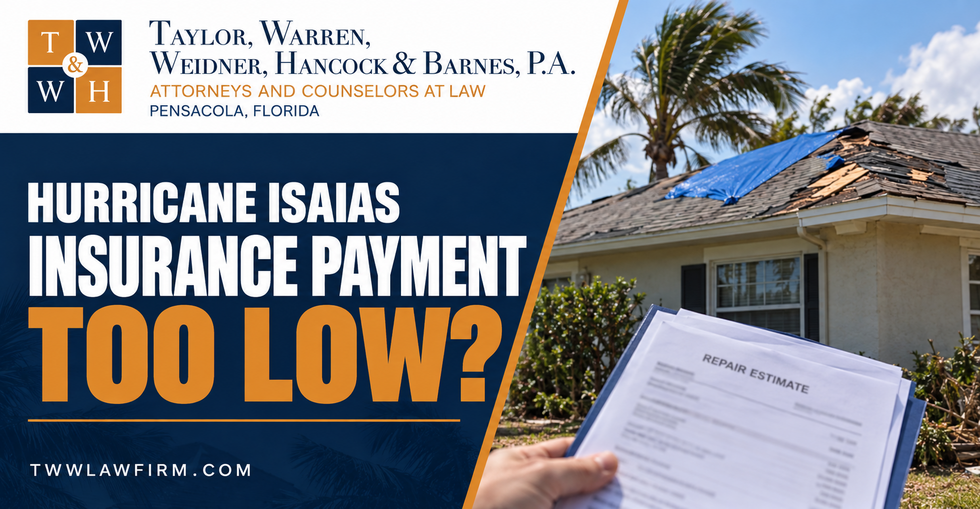
Getting an insurance check after Hurricane Isaias should feel like progress. But what happens when the payment falls far short of what contractors say it will cost to repair your home?
An insurance company does not have to deny your claim outright to leave you facing a substantial financial burden. It may acknowledge storm damage but underestimate the work needed to repair it. Understanding the difference between a properly calculated payment and an underpaid claim can help you protect your recovery.
A Payment Does Not Always Mean the Claim Is Fully Paid
An insurer's initial payment may reflect only part of the benefits available under your policy. Before assuming the amount is correct—or that it is necessarily an underpayment—review the estimate and payment explanation.
Look for:
- The total repair cost the insurer approved
- The deductible applied to your claim
- Any depreciation withheld
- Damage the insurer excluded or did not address
- Any explanation of additional payments that may become available
Replacement cost coverage and actual cash value coverage work differently. Depending on your policy, some withheld depreciation may become payable after qualifying repairs and documentation. Other deductions may require closer examination.
Missing Work Can Leave You Paying the Difference
An estimate can look thorough while leaving out necessary repairs. The problem may involve the scope of work—the specific materials, labor, and repair tasks included.
For example, an estimate might account for replacing damaged shingles but omit related work needed to complete the covered repair. It might also contain incorrect measurements or overlook damage to another part of the property.
Questions worth asking include:
- Does the estimate identify every damaged area?
- Are the measurements and quantities accurate?
- Does it include the labor needed to complete each repair?
- Are the proposed repairs consistent with the documented damage?
A detailed comparison can reveal disagreements that the payment amount alone does not explain.
Repair Prices Matter Too
Even when an insurer and contractor agree about what needs repairing, they may disagree about the cost.
An estimate may use labor or material prices that differ from actual local quotes. However, a higher contractor estimate does not automatically establish what the insurer owes. The work must also relate to covered damage and satisfy the policy's requirements.
Ask your contractor for an itemized estimate explaining the proposed work, quantities, materials, and prices. Specific differences are easier to evaluate than competing lump-sum totals.
Understand Your Deductible Before Comparing Numbers
Your hurricane deductible can account for a significant difference between the estimated damage and the check you receive. A percentage deductible is generally calculated using the applicable insured dwelling limit, rather than the amount of your repair bill.
That does not mean every deduction is correct. Ask the insurer to explain which deductible applies and how it calculated the amount.
An Attorney Can Help Identify the Real Dispute
Challenging an underpaid claim requires more than telling the insurer its check is too small. It requires identifying what is missing, explaining why it matters, and supporting the requested payment.
An attorney can help:
- Review your policy, estimate, and payment explanation
- Compare the insurer's position with repair documentation
- Present evidence supporting disputed costs
- Evaluate available options for resolving the disagreement
- Identify applicable deadlines and policy requirements
Depending on the dispute and eligibility, Florida's residential property mediation program may offer an opportunity to seek a resolution. Other options depend on the policy and circumstances.
The Bottom Line from Taylor, Warren, Weidner, Hancock & Barnes
If your Hurricane Isaias insurance payment will not cover the repairs you believe your policy should pay for, do not assume the insurer's estimate settles the question.
At Taylor, Warren, Weidner, Hancock & Barnes, P.A., we help Florida homeowners address insurance disputes and pursue the benefits available under their policies. Contact us to discuss your payment, understand the disagreement, and explore your legal options.


Comments
There are no comments for this post. Be the first and Add your Comment below.
Leave a Comment