
Electric bicycles and scooters are no longer a novelty.
Whether you're visiting Pensacola Beach, commuting to work, delivering food, or simply enjoying a weekend ride, chances are you've seen more e-bikes on Florida roads than ever before. Their popularity continues to grow because they're affordable, convenient, environmentally friendly, and often faster than sitting in traffic.
But while transportation has changed dramatically over the past decade, much of Florida's infrastructure has not.
Many of our roads, sidewalks, bike lanes, and intersections were designed decades before anyone imagined thousands of electric bicycles traveling up to 20 or even 28 miles per hour alongside cars and pedestrians.
That mismatch is creating new safety concerns throughout the state.
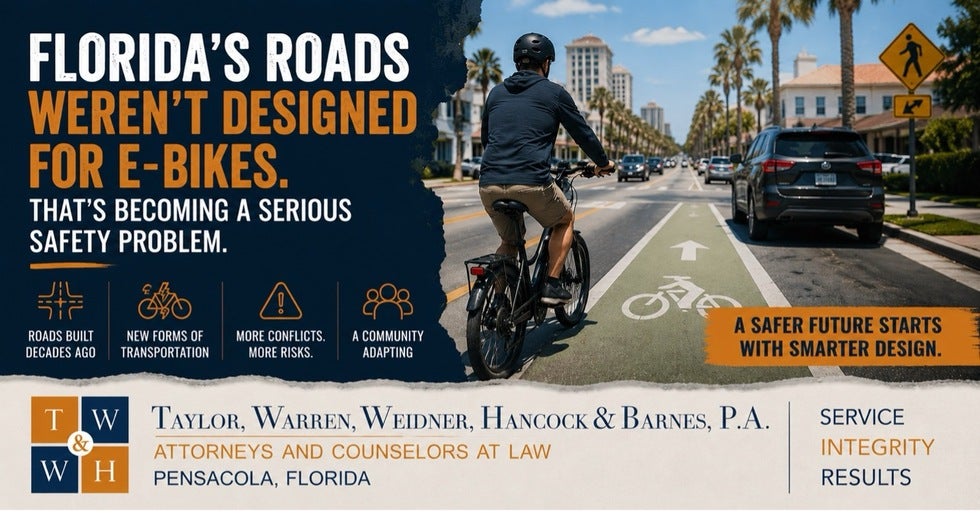
More Ways to Travel, But the Same Amount of Space
Florida's transportation network now serves a much wider variety of users than it once did.
On any given road or neighborhood street, you may find:
- Passenger vehicles
- Commercial trucks
- Traditional bicycles
- Electric bicycles
- E-scooters
- Golf carts
- Pedestrians
- Runners
- Delivery riders
Unfortunately, most roads were never designed to safely accommodate all of them at the same time.
Bike lanes may suddenly disappear.
Sidewalks become crowded with pedestrians.
Drivers may not know whether an e-bike belongs in the roadway or on the sidewalk.
Riders often have to make split-second decisions about where they feel safest.
The result isn't necessarily reckless behavior—it's confusion.
Intersections Remain One of the Biggest Danger Zones
Some of the most serious crashes occur at intersections.
Drivers approaching an intersection often expect traffic to move at predictable speeds.
An electric bicycle, however, can cover ground much more quickly than a traditional bicycle.
At the same time, riders may assume drivers have already seen them.
That difference in expectations can lead to dangerous collisions, especially when visibility is limited by parked vehicles, landscaping, or busy commercial areas.
Even experienced drivers and riders can find themselves making the wrong assumption in just a matter of seconds.
Tourist Communities Face Unique Challenges
Communities along Florida's Gulf Coast experience an additional layer of complexity.
Places like Pensacola Beach, Destin, Panama City Beach, and many other coastal destinations attract visitors who may be unfamiliar with local roads, bicycle laws, or traffic patterns.
Some visitors rent e-bikes or scooters for the first time while on vacation.
Others drive unfamiliar rental vehicles through crowded pedestrian areas.
When local residents, tourists, pedestrians, bicycles, golf carts, and electric scooters all converge in the same areas, the potential for confusion increases dramatically.
Infrastructure Is Beginning to Catch Up
Transportation planners throughout Florida are recognizing that communities must adapt as new forms of transportation become more common.
Cities are evaluating safer bike lane designs, improved shared-use paths, clearer signage, and roadway improvements intended to reduce conflicts between motorists, cyclists, and pedestrians.
At the state level, lawmakers have also updated Florida's e-bike laws to address issues such as sidewalk speeds, yielding to pedestrians, and rider responsibilities.
These changes acknowledge an important reality: today's transportation system looks very different than it did even ten years ago.
For more information about Florida's current e-bike laws and rider responsibilities, the Florida Department of Highway Safety and Motor Vehicles provides a helpful overview:
https://www.flhsmv.gov/safety-center/driving-safety/bicycle-safety/
The Bottom Line from TWWLAWFIRM.COM
Electric bicycles are likely here to stay, and they offer many benefits for Florida residents and visitors alike. The challenge isn't simply teaching riders or drivers to behave more safely—it's recognizing that our roads and sidewalks are evolving faster than the infrastructure surrounding them.
Until communities continue adapting to this changing landscape, everyone shares responsibility. Drivers should expect to see more e-bikes on the road. Riders should remain alert around intersections and driveways. Pedestrians should stay aware in shared-use spaces.
A little patience and awareness from everyone can go a long way toward preventing serious injuries.


Comments
There are no comments for this post. Be the first and Add your Comment below.
Leave a Comment