
When a serious crash occurs and someone is injured or killed, families are often left searching for answers.
Sometimes those questions arise when alcohol or drug impairment is suspected.
Family members may wonder:
"Why wasn't the driver arrested for DUI?"
"Why wasn't a breath test performed at the scene?"
"Why haven't charges been filed?"
These are understandable questions, particularly when the consequences of a crash are fatal or life-changing. But what many people do not realize is that criminal investigations and civil investigations serve different purposes—and they operate under very different rules and standards.
Understanding those differences can help explain why important questions sometimes remain unanswered after the initial law enforcement investigation.
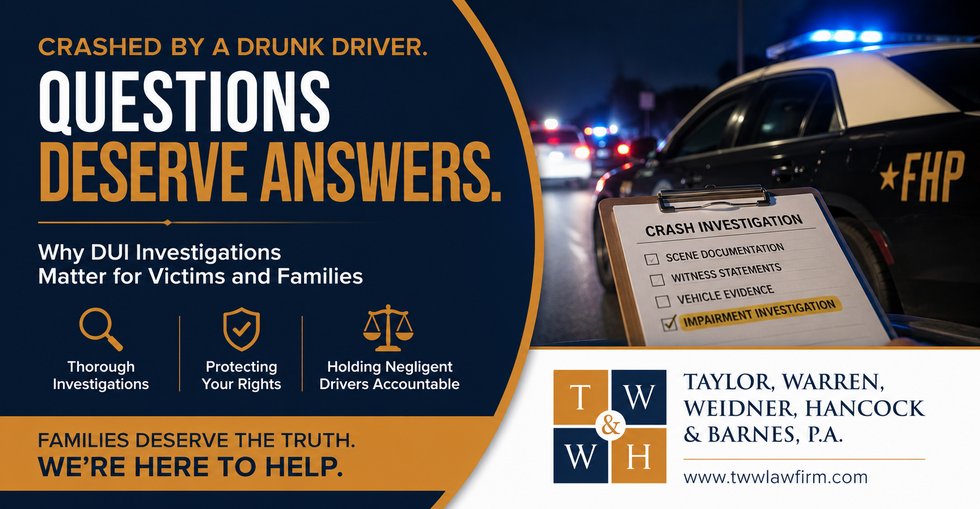
Law Enforcement Faces Significant Responsibilities at Crash Scenes
Law enforcement officers responding to serious crashes have difficult jobs.
Their first responsibilities are often to:
- Secure the scene
- Protect motorists and first responders
- Provide emergency assistance
- Coordinate with medical personnel
- Document evidence
- Interview witnesses
- Determine whether criminal laws may have been violated
All of this frequently occurs in chaotic and dangerous conditions.
Officers must also comply with constitutional protections that apply in criminal investigations. Unlike a civil case, where the goal is often to determine financial responsibility, criminal investigations must satisfy legal standards designed to protect individual rights.
Those protections are important. They help ensure that criminal charges are based on admissible evidence and that prosecutions are conducted fairly.
Criminal Cases Require Specific Legal Standards
Many people assume that if alcohol may have played a role in a crash, testing should automatically occur. In reality, criminal investigations are often more complicated.
Drivers may be transported to hospitals before officers can complete an investigation. Medical treatment may take priority over evidence collection. Witnesses may provide conflicting information. Signs of impairment may not be immediately apparent.
Officers must also make decisions based on available evidence and applicable legal requirements—not assumptions. As a result, there are situations where a criminal investigation may not immediately produce all of the answers a family is seeking.
That does not necessarily mean the investigation was inadequate. It often reflects the realities of conducting a criminal investigation within constitutional and practical limitations.
Why Civil Investigations Exist
The civil justice system serves a different function.
While criminal courts focus on whether a crime occurred and whether punishment is appropriate, civil cases focus on accountability and compensation for those who have been harmed.
Civil investigations can often continue long after the crash scene has been cleared.
They may involve:
- Additional witness interviews
- Surveillance footage
- Vehicle data recorder information
- Cell phone records
- Business records
- Accident reconstruction
- Toxicology evidence
- Evidence regarding alcohol service or other negligent conduct
In many cases, civil investigations uncover information that was not available to officers at the scene or during the initial stages of a criminal investigation.
That is one reason the civil justice system plays such an important role.
Different Systems, Different Purposes
Criminal and civil investigations are not competing systems.
They are complementary.
Law enforcement officers work to determine whether criminal laws were violated while operating within constitutional safeguards and often under significant time and resource constraints.
Civil attorneys investigate whether negligent conduct caused harm and whether victims and families are entitled to compensation and often have more time and resources at their disposal.
Both systems seek the truth, but they do so through different processes and different legal standards.
The Bottom Line from TWWLAWFIRM.COM
When questions remain, a civil investigation can help uncover facts, preserve evidence, and pursue accountability for the harm caused by an intoxicated or otherwise negligent driver.
Because after a life-changing crash, accountability should not depend solely on what happened at the scene. It should depend on following the evidence wherever it leads.
If your family has questions following a serious crash, the experienced car crash attorneys at Taylor, Warren, Weidner, Hancock & Barnes, P.A. can help evaluate the circumstances, preserve evidence, and investigate what happened.
Because when lives are changed in an instant, the search for the truth matters.


Comments
There are no comments for this post. Be the first and Add your Comment below.
Leave a Comment