
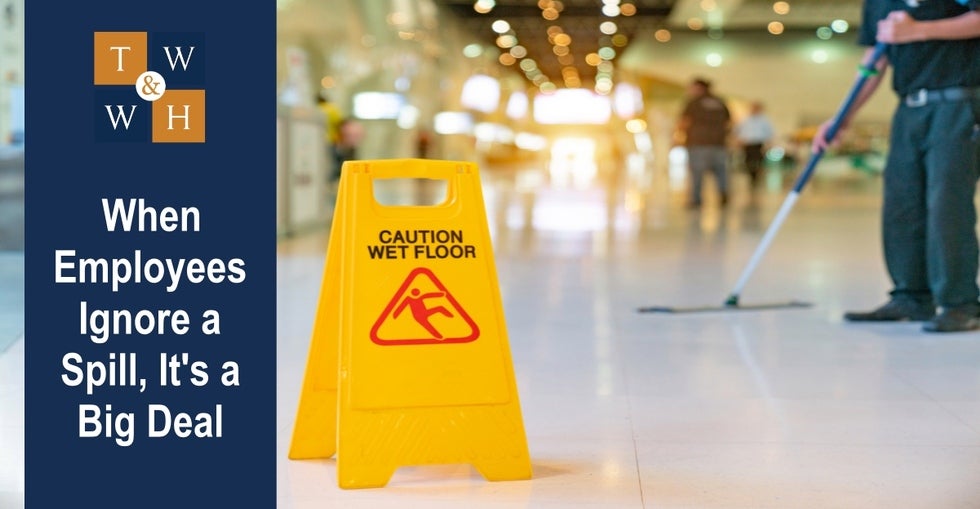
At Taylor, Warren, Weidner, Hancock & Barnes, P.A., we often hear people downplay slip-and-fall incidents as “just accidents.” But a recent Florida appellate decision serves as a powerful reminder: dangerous conditions in commercial establishments are often preventable—and when they're ignored, serious injuries—and responsibility—can follow.
In Ouedraogo v. Walmart Stores East, LP, Florida's First District Court of Appeals reversed the lower court's entry of judgment in favor of Wal-Mart and ruled in favor of the customer who fell on a dangerous condition that sat unnoticed by employees for eight minutes. What makes this case particularly important is not just the fall itself—but what happened before it.
The Danger Was There—And It Was Seen
According to the court record, surveillance footage showed that the condition had been on the floor for nearly eight minutes before the incident. During that time, several employees were in the area, and at least one walked directly past the hazard.
Despite this evidence, the trial court initially ruled in favor of the store, essentially concluding that the employees may not have noticed the hazard—even though they were nearby. But the appellate court disagreed. It reversed that decision, emphasizing that these facts created a legitimate question for a jury: should the business have known about—and fixed—the dangerous condition?
Why This Matters for Everyday People
This case highlights an issue we see all too often: businesses failing to take reasonable steps to keep their premises safe. Under Florida law, businesses owe a duty to their customers (legally called “invitees”) to maintain reasonably safe conditions. When something like a spill or debris is left unattended, it can quickly become a serious hazard.
Importantly, the law doesn't require proof that a business actually knew about the danger. Instead, it allows injured individuals to prove “constructive knowledge”—meaning the condition existed long enough (in the Ouedraogo case, eight minutes) that the business should have known about it.
And here's the key Ouedraogo takeaway: even a few minutes can be enough to raise that question.
Dangerous Conditions Are Often Preventable
A spill on a grocery store floor might sound trivial. However, in reality, it represents a breakdown in basic safety practices:
- Failure to monitor high-traffic areas
- Lack of timely cleanup procedures
- Employees not paying attention to hazards in plain view
Retail stores, grocery stores, and other commercial establishments are busy environments. But that's exactly why safety protocols must be consistent and proactive.
When businesses cut corners—even unintentionally—the consequences can be severe.
What You Should Watch For
As a customer, there are a few things to keep in mind when you're in a store or public place:
- Be cautious in entryways, produce sections, and other spill-prone areas
- Pay attention to warning signs—or the absence of them
- Report hazards if you see them (it could prevent someone else from getting hurt)
But just as importantly, understand this: if you are injured, it may not be your fault.
BOTTOM LINE FROM TWWLAWFIRM.COM
👉 At Taylor, Warren, Weidner, Hancock & Barnes, P.A., we believe accountability matters—not just for our clients, but for the safety of the entire community. When dangerous conditions are addressed promptly, injuries can often be prevented altogether.
If a dangerous condition existed long enough that a business should have discovered and fixed it, you may have a valid claim. Don't assume your injury was “just an accident”—let our team of experienced personal injury attorneys look into it and make sure you understand your rights.

Comments
There are no comments for this post. Be the first and Add your Comment below.
Leave a Comment