
The United States Supreme Court recently issued an important decision affecting trucking accident litigation nationwide. In Montgomery v. Caribe Transport II, LLC, the Court ruled that federal law does not automatically protect freight brokers from negligence claims when they are accused of hiring unsafe trucking companies.
For victims injured in serious trucking accidents, the decision highlights an important reality: liability may extend beyond the truck driver and trucking company themselves.
What Happened in the Case?
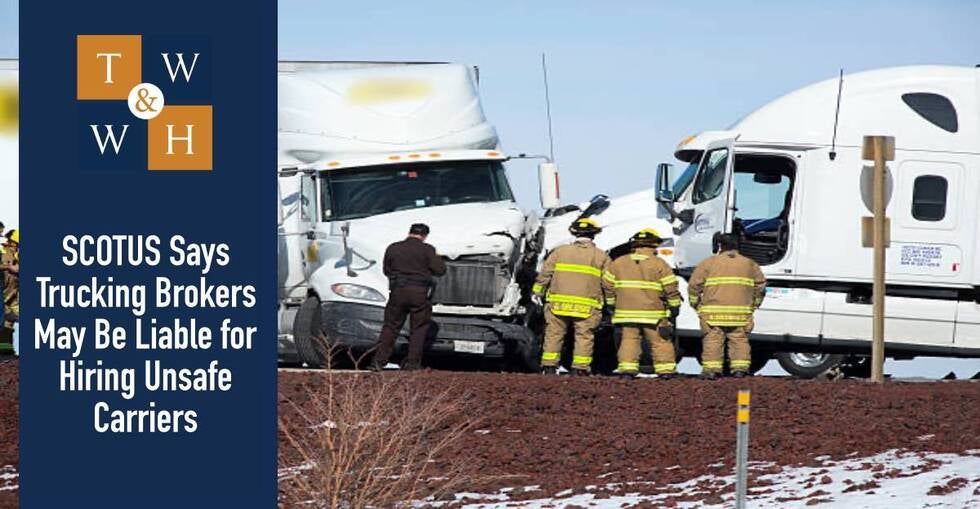
According to the Supreme Court's opinion, plaintiff Shawn Montgomery suffered catastrophic injuries after his tractor-trailer was struck by another commercial truck operating in Illinois. The crash resulted in the amputation of Montgomery's leg and other severe, permanent injuries.
The lawsuit alleged that the freight broker responsible for coordinating the shipment—C.H. Robinson Worldwide—negligently hired Caribe Transport, a motor carrier that allegedly had a troubling federal safety history and a “conditional” safety rating.
Montgomery claimed the broker either knew or should have known that hiring the carrier created an unreasonable risk of harm to the public.
The Legal Issue: Does Federal Law Protect Freight Brokers?
The central legal issue involved the Federal Aviation Administration Authorization Act (FAAAA), a federal law that limits certain state regulations affecting the trucking industry.
Freight brokers argued that the FAAAA broadly preempted—or barred—state negligence claims against brokers because those claims related to trucking “services.” Lower courts initially agreed with that argument and dismissed the negligence claim.
But the Supreme Court unanimously disagreed.
Justice Barrett, writing for the Court, explained that while the FAAAA preempts some state regulation of the trucking industry, Congress specifically preserved state authority involving motor vehicle safety.
The Court concluded that negligence claims involving the hiring of unsafe trucking companies directly concern motor vehicle safety and therefore fall within the law's “safety exception.”
Why This Decision Matters
This decision is significant because it recognizes that responsibility for trucking safety may extend beyond the driver and motor carrier.
Modern trucking and shipping operations are often complex. A single load often involves three or more of the following parties:
- The truck driver
- The motor carrier
- A freight broker
- A shipping company
- Maintenance providers
- Multiple insurance carriers
In many cases, brokers play a substantial role in selecting which trucking companies transport freight across the country.
The Supreme Court's ruling reinforces that companies involved in arranging transportation may, in some circumstances, be held accountable if they ignore serious safety concerns when choosing carriers.
Read the full Montgomery v. Caribe Transport II, LLC opinion.
Complex Trucking Cases Require Extensive Investigation
Serious trucking accident cases are often far more complicated than ordinary automobile accident claims.
Investigating these crashes may require reviewing:
- Federal safety ratings
- Driver qualification files
- Hours-of-service violations
- Maintenance and inspection records
- Crash histories
- Internal company communications
- Electronic logging data
- Broker-carrier relationships
These cases frequently involve overlapping federal regulations, multiple corporate defendants, and aggressive insurance defense efforts that begin immediately after a crash.
Justice Kavanaugh's Concurrence Highlights Safety Concerns
In a concurring opinion, Justice Kavanaugh acknowledged the practical realities facing the trucking industry while emphasizing the importance of safety accountability.
He noted that brokers are not expected to guarantee perfect safety, but they may still face liability if they disregard obvious warning signs involving unsafe trucking companies or drivers.
The opinion also recognized the devastating consequences that commercial trucking accidents can have on individuals and families across the country.
How Our Firm Handles Complex Trucking Cases
At Taylor, Warren, Weidner, Hancock & Barnes, P.A., we understand that serious trucking accident cases often involve far more than just the actions of a single driver.
Commercial trucking litigation may require identifying every potentially responsible party and thoroughly investigating the safety practices, hiring decisions, and regulatory compliance issues involved in the transportation process. Here's partner, Keith Weidner, in one of our Legal Minute Videos, explaining further.
This Supreme Court decision serves as an important reminder that accountability in the trucking industry may reach beyond the company operating the truck itself—particularly when safety warning signs are ignored.
If you or a loved one has been injured in a trucking accident, it is important to understand that these cases can involve complicated legal and factual issues that require careful investigation from the very beginning.


Comments
There are no comments for this post. Be the first and Add your Comment below.
Leave a Comment