
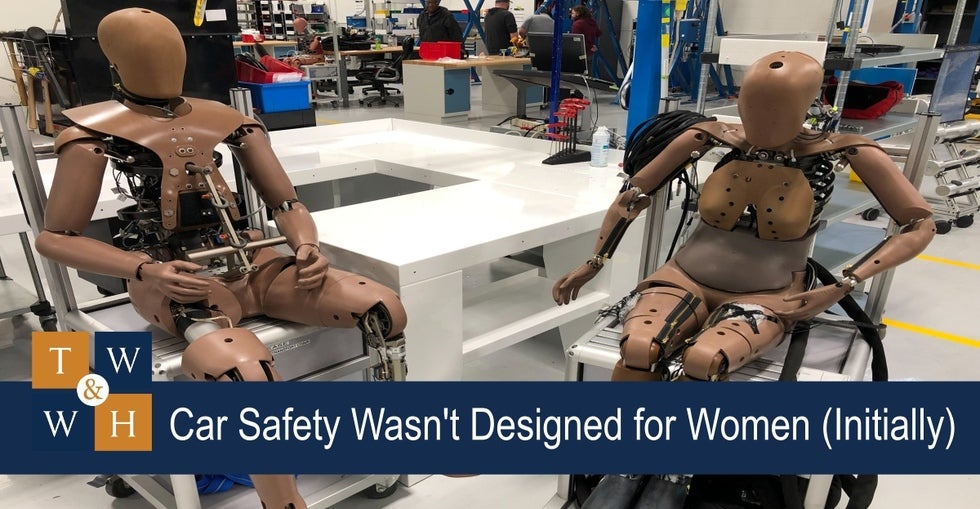
If you watched or read the recent New York Times piece on car safety and crash test dummies, one takeaway should stop you in your tracks:
For decades, cars have largely been designed and tested using male bodies—not female ones.
That's not just a technical oversight. It has real-world consequences for women on the road every single day.
The Data Is Clear: Women Are at Greater Risk
Recent research confirms what safety advocates have been saying for years: women are more likely to be injured in car crashes than men, even when the crash conditions are the same.
In fact:
- Women face up to a 46% higher risk of injury in frontal crashes;
- They are significantly more likely to suffer lower-extremity and pelvic injuries; and
- Studies have also shown women can be more likely to be seriously injured or killed in comparable crashes.
Why? Because historically, crash test dummies were modeled after an average-sized man—and “female” dummies were often just smaller versions of that same male model. That means critical differences (like pelvis structure, muscle distribution, and how seatbelts interact with the body) weren't properly accounted for.
Why This Matters in Real Life
This isn't about abstract engineering. It affects how:
- Seatbelts fit across your body;
- Airbags deploy in a crash; and
- Your body absorbs impact forces.
For example, differences in pelvis shape can change how a seatbelt sits—and whether it protects you or contributes to injury.
In other words, even if you're doing everything “right” as a driver, the system itself hasn't always been designed with you in mind.
Progress Is Happening, But It's Slow
There is some good news: A new generation of crash test dummies—like the THOR-05F—has been developed to better reflect female anatomy. These advanced models include significantly more sensors and more realistic body mechanics.
But here's the reality:
It may take years before these improvements are fully adopted across the automotive industry.
Until then, many vehicles on the road today were tested using outdated models that don't fully represent female drivers.
WOMEN: How to Improve Your Safety in an Accident
While we can't redesign vehicles overnight, there are steps you can take right now to better protect yourself:
1. Adjust Your Seat Properly
Sit upright with your hips all the way back and maintain at least 10 inches between your chest and the steering wheel.
2. Position Your Seatbelt Correctly
The lap belt should sit low across your hips (not your stomach), and the shoulder belt should cross the center of your chest—not your neck or arm.
3. Don't Sit Too Close to the Wheel
Many women sit closer due to height. If needed, adjust pedals or use a vehicle with adjustable controls.
4. Be Especially Cautious with Smaller Vehicles
Size and weight still matter in crashes. When possible, consider vehicles with strong safety ratings.
5. Take Symptoms Seriously After a Crash
Women are more prone to certain injuries—especially soft tissue and lower-extremity injuries. Don't ignore pain that develops hours or days later.
Why This Is Also a Legal Issue
From a legal standpoint, this issue raises an important reality:
Injury risk is not always about driver behavior—it can be about design.
If you've been injured in a crash, understanding why your injuries occurred matters. It may involve:
- Vehicle design limitations;
- Safety system performance; or
- Biomechanical differences that weren't accounted for.
At Taylor, Warren, Weidner, Hancock & Barnes, our experienced personal injury attorneys we look beyond the surface of an accident. Because protecting your rights means understanding the full picture.
Bottom Line from TWWLawFirm.com
👉 If you're a woman involved in a car accident, your injuries may not be “just bad luck.” The system itself hasn't always been built with you in mind—and that matters.


Comments
There are no comments for this post. Be the first and Add your Comment below.
Leave a Comment